
In stock
Gold Testing
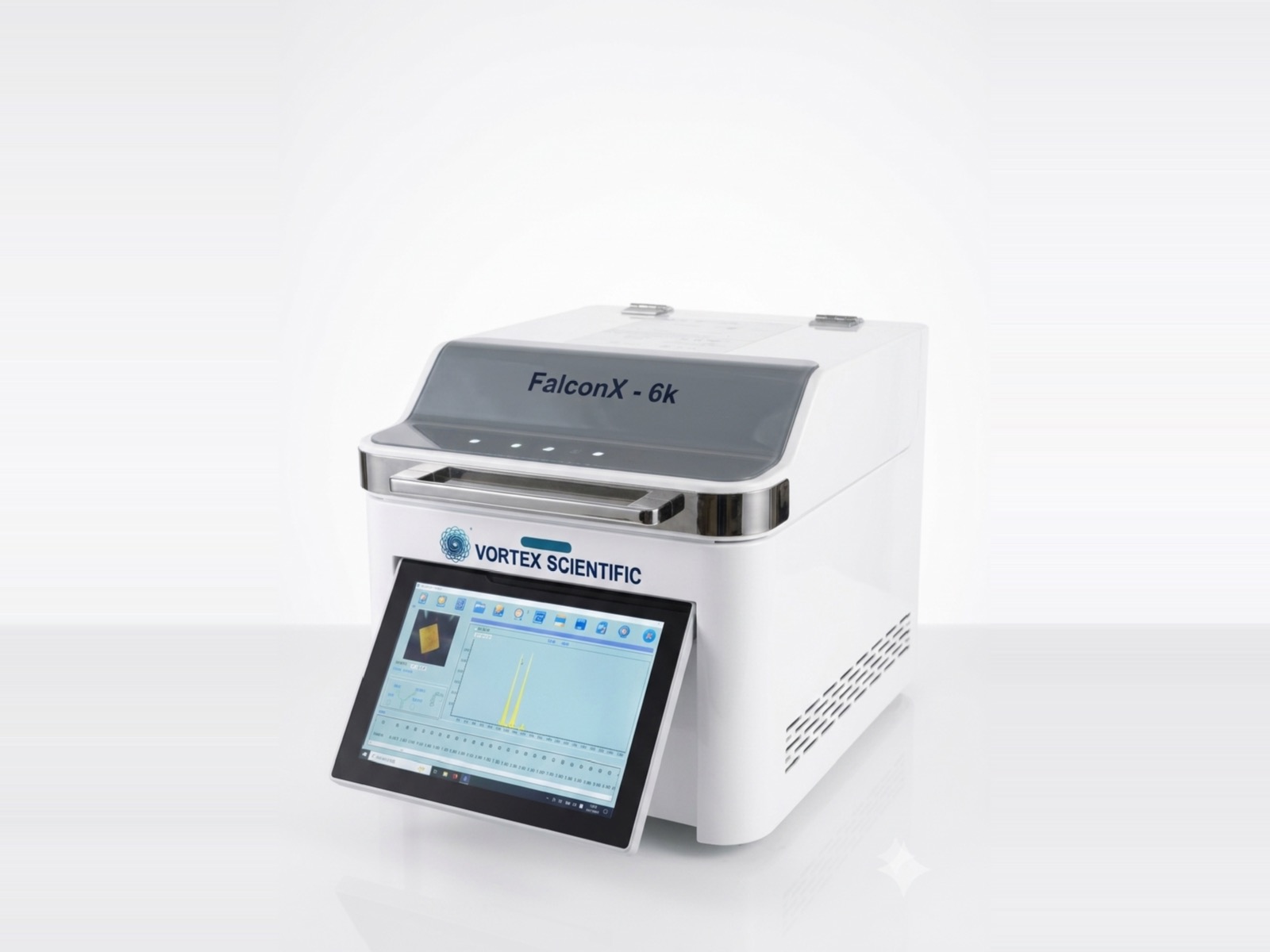
FalconX-6k
Benchtop XRF analyser with a silicon drift detector — karat and full alloy composition in seconds, non-destructive.
TechniqueEnergy-dispersive X-ray fluorescence (EDXRF)
USD 13,999
Gold-industry machinery for jewellers and bullion traders
info@vortexscientific.comRange
Non-destructive XRF analysers that read karat purity and full alloy composition in seconds, without acid, touchstone or scraping.
2 machines
Gold Testing
Benchtop XRF analyser with a silicon drift detector — karat and full alloy composition in seconds, non-destructive.
TechniqueEnergy-dispersive X-ray fluorescence (EDXRF)
Gold Testing
Compact XRF karat tester for over-the-counter buy-back — fast sorting into karat bands on a small footprint.
TechniqueEnergy-dispersive X-ray fluorescence (EDXRF)
An XRF analyser answers one question that decides whether a trade is profitable: what is actually in this piece of metal? It does it without acid, without a touchstone and without removing a single milligram from the item: a customer will let you test their bangle, and a refiner will accept your figure without re-assaying.
The first thing to settle is what you are testing. A shop buying back old jewellery needs a machine that handles small, irregular, hollow and stone-set pieces, and reports karat clearly enough to show a customer on screen. A bullion desk or refinery has a different priority: tight repeatability on bars and grain at high purity, because at 995 and above a disagreement of one part per thousand is real money. Karat-range accuracy on a finished ring and precision at 999 are not the same specification, so ask for both figures separately.
Detector type is the biggest driver of price and performance. Silicon drift detectors (SDD) resolve the gold, silver, copper, zinc, nickel and cadmium peaks cleanly and settle in a few seconds. Proportional counter (PIN) instruments cost meaningfully less and are fine for sorting scrap into karat bands, but they take longer per reading and struggle to separate elements that sit close together in the spectrum. If you are paying cash against the number on the screen, buy the better detector.
Watch for plating and surface effects. XRF reads the surface, typically the top few microns. A heavily gold-plated brass item can present as high-karat gold to any XRF machine on the market — this is a physical limit of the technique, not a fault in a particular unit. Serious buyers pair XRF with a density check, or file a small window on scrap before testing. Any supplier who says their analyser cannot be fooled by plating is overselling it; ask instead how it flags a suspicious reading.
Practical things that decide whether the machine gets used daily: chamber size against the largest item you handle, whether the camera and collimator let you aim at a clasp rather than averaging over a stone setting, how long a reading takes, whether results export, and how the software presents karat versus percentage composition. Add two more wherever you are: mains supply quality at your bench, and who services the unit. An XRF tube and detector are not roadside repairs — confirm before purchase who handles calibration, tube replacement and software support, and how long a unit is away when it needs them.
Finally, ask about radiation safety documentation and registration. These are sealed-source-free, tube-based instruments with interlocked chambers, and a compliant unit is safe to operate in a retail shop. But many jurisdictions — including individual US states — require an X-ray-producing device to be registered before it is switched on, and some require a named operator. Ask what paperwork ships with the machine, and check what your own authority requires. [TO CONFIRM: which registrations Vortex Scientific handles on the customer's behalf]
Reading
8 min read
A plain-language explanation of X-ray fluorescence for jewellers — what the machine actually measures, why it cannot be fooled by acid tricks but can be fooled by plating, and how to read a result you are about to pay against.
Read guide
No. XRF is non-destructive. The item sits in a sealed chamber and is measured with low-energy X-rays; nothing is scraped, dissolved or removed, so the piece is returned to the customer exactly as it came in.
XRF reads the surface layer of an item, so a thick plating can read as solid high-karat gold. This is a limitation of the technique itself rather than of any one machine. Standard practice is to combine XRF with a density check, or to test a filed area on scrap where plating has been broken through.
Typical measurement times run from a few seconds for a karat sort to a longer count when you need tighter precision on high-purity material. Longer counts collect more signal and produce a more repeatable number.
Tube-based benchtop analysers with an interlocked, shielded chamber are designed for exactly this environment. The chamber must be closed before the tube can fire. Ask your supplier for the unit's safety documentation, keep it with the machine, and check whether your jurisdiction requires the device to be registered.
Most shops stop using acid for routine work because XRF is faster, non-destructive and gives a full composition rather than a pass or fail. Many keep a simple density check as a second opinion on unusually valuable or unusually suspicious items.
Talk to us
Tell us your shop size, your power supply and what you melt or test in a day. We will tell you which machine fits — including when the answer is the cheaper one.
Other ranges: Gold Melting Furnaces · Laser Welding Machines · Ultrasonic Cleaners