
In stock
Melting Furnaces
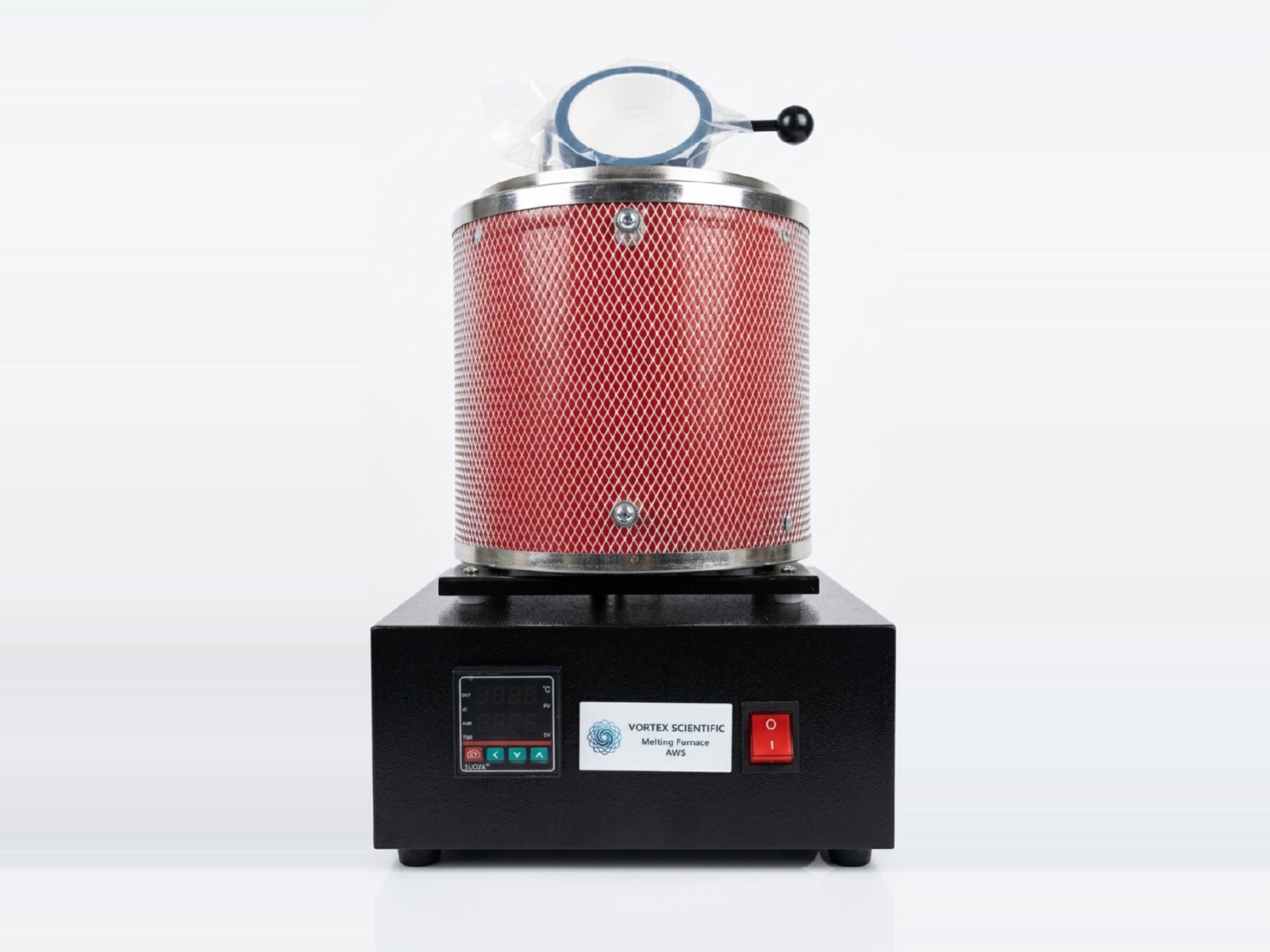
Vortex Vulcan
1 kg induction melting furnace for retail jewellers — full charge to pour in minutes, with set-and-hold temperature control.
Melting capacity1 kg (gold)
USD 1,950
Gold-industry machinery for jewellers and bullion traders
info@vortexscientific.comRange
Compact induction furnaces that take gold, silver and karat alloys from scrap to a clean pour in minutes, with controlled temperature and low metal loss.
2 machines
Melting Furnaces
1 kg induction melting furnace for retail jewellers — full charge to pour in minutes, with set-and-hold temperature control.
Melting capacity1 kg (gold)
Melting Furnaces
3 kg water-cooled induction furnace for workshops and bullion desks running back-to-back melts.
Melting capacity3 kg (gold)
A melting furnace is judged on three things: how fast it reaches pouring temperature, how little metal it costs you per melt, and how long it runs before something needs replacing.
Start with capacity, and size it to your busiest day rather than your average one. A retail shop that melts customer buy-backs and casts small items is well served by a 1 kg class furnace; it heats quickly, uses a small crucible, and wastes very little metal on a part-full charge. A workshop supplying several counters, or a dealer consolidating scrap into bars, will find 1 kg becomes the bottleneck and should look at 2–3 kg. Going larger than you need is not free: a big crucible run half empty holds more heat, takes longer, and leaves more metal in the lining. Two smaller melts often beat one oversized one.
Induction is now the default, and for good reason. The coil heats the charge itself rather than a chamber around it, so a melt that took twenty minutes in a resistance furnace takes a few, and the metal spends less time hot and oxidising. The field also stirs the melt, mixing an alloy far more evenly than a static one — which matters if you are adding copper and silver to hit a karat.
Power supply is where most installations go wrong. Settle three things before you order: the voltage and frequency at your premises, whether you have single-phase or three-phase available, and the peak draw rather than the rated draw. Machines are built for a supply — 110–120 V at 60 Hz, or 220–240 V at 50 Hz — and one configured for the wrong one is not a small fix. Check the voltage you see under load, not the figure on the meter: a supply that sags makes a furnace slow and works its electronics harder. If you run on a generator, say so before you buy.
Cooling is not an accessory. Induction power supplies dump heat, and a water-cooled unit will hold temperature and last longer under back-to-back melts than an air-cooled one, but it introduces a chiller or a water circuit you have to actually maintain. Air-cooled units are simpler and fine for intermittent shop use. Match this to your duty cycle honestly.
Then look at the parts you will keep buying. Graphite crucibles are consumables, and over three years their cost and availability matter more than the furnace's sticker price. Confirm the crucible is a standard size you can source locally, wherever you are. The same goes for the coil, the thermocouple, tongs and moulds.
Finally, temperature control. A basic furnace gives you a power dial and asks you to judge the melt by eye. A controlled unit lets you set a target and hold it, which protects you from overheating a charge, burning off zinc from a karat alloy, and quietly shifting the composition of metal you are about to sell by weight. If you melt anything other than fine gold, this pays for itself.
Reading
9 min read
How to size an induction melting furnace to your actual workload, what power supply and cooling really demand of a working shop, and the running costs that matter more than the purchase price.
Read guide
A 1 kg class induction furnace covers most retail shops — buy-backs, small casting and routine remelting. Step up to 2–3 kg only if you regularly melt more than a kilogram in one session, or if you are consolidating scrap into bars for a refiner.
A small induction furnace typically brings a full charge of gold to pouring temperature in a few minutes, compared with fifteen to twenty minutes for a resistance furnace of similar capacity. Exact time depends on charge size, metal and available input power.
Yes. Induction furnaces in this class handle gold, silver and the usual karat alloys. Keep separate crucibles for different metals so you are not carrying contamination from one melt into the next.
Smaller units generally run on single-phase; higher-capacity furnaces often require three-phase. Confirm the requirement against the supply at your premises before ordering, tell us your local voltage and frequency so the unit is configured for it, and account for the voltage you actually get under load rather than the nominal figure.
Graphite crucibles are consumables and their life depends on how hot you run, how often you thermal-cycle them and how carefully they are handled. Treat them as a running cost and keep a spare, so a cracked crucible never stops work for a day.
Talk to us
Tell us your shop size, your power supply and what you melt or test in a day. We will tell you which machine fits — including when the answer is the cheaper one.
Other ranges: Gold Testing Machines · Laser Welding Machines · Ultrasonic Cleaners