9 min read
Choosing a gold melting furnace for your shop
How to size an induction melting furnace to your actual workload, what power supply and cooling really demand of a working shop, and the running costs that matter more than the purchase price.
The furnace is the least glamorous machine in a jewellery workshop and the one that quietly costs you money if it is chosen badly. Not through its purchase price — through metal loss, through time, and through consumables you did not budget for.
This guide is about picking the right one the first time.
Start with capacity, and be honest about it
The instinct is to buy bigger than you need, on the reasoning that you will grow into it. With a melting furnace this is usually wrong.
A crucible run half empty is not simply an underused crucible. It is a larger mass of ceramic and graphite that has to be brought up to temperature along with your metal, and that takes longer and holds more heat. It also leaves more metal behind in the lining, because the wetted surface area is out of proportion to the charge. Over a year of small melts in an oversized furnace, that is real gold sitting in a crucible you eventually throw away.
Size to your busiest realistic day, not your largest imaginable one.
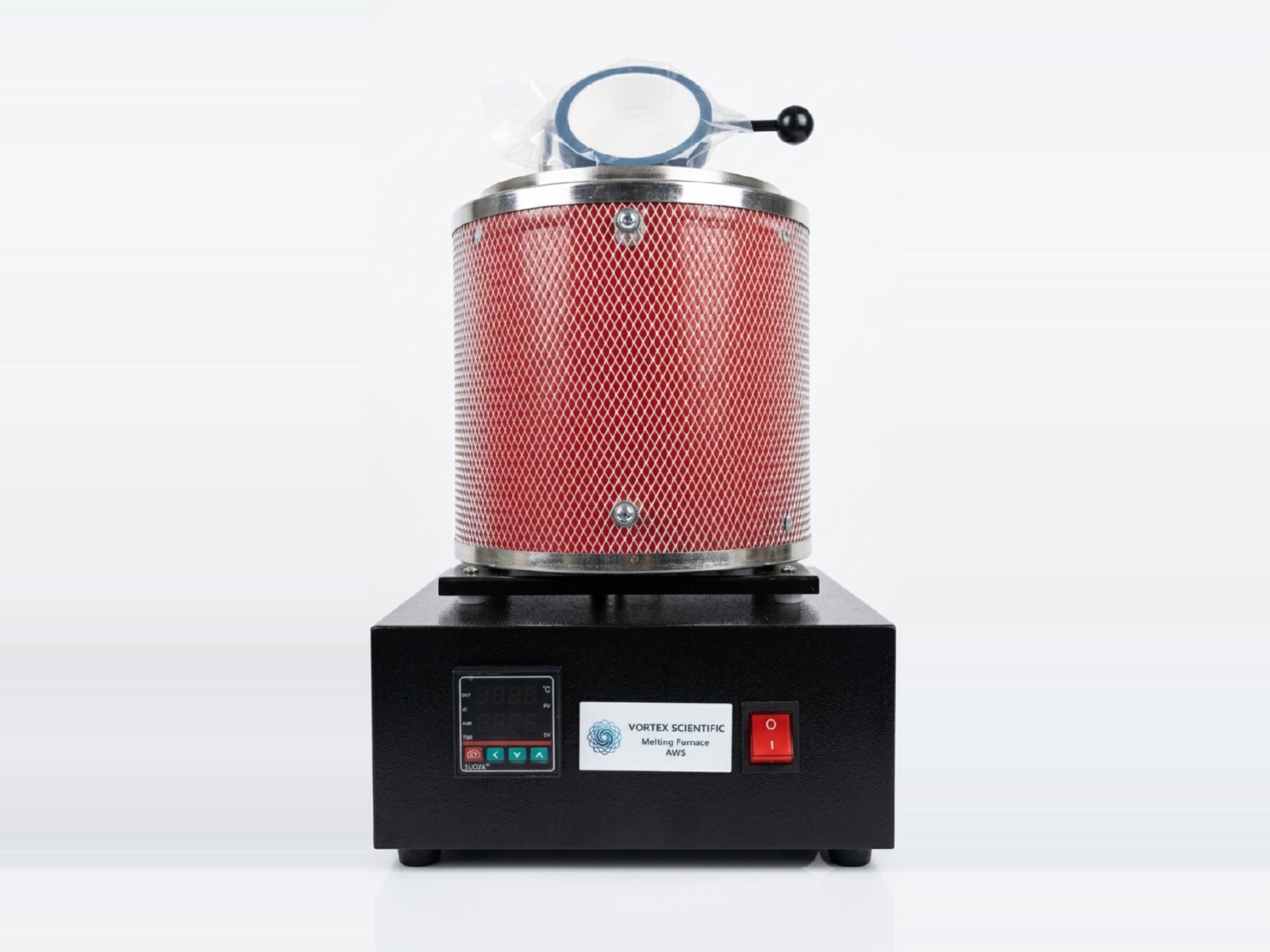
- 1 kg class — a retail shop melting customer buy-backs, bench scrap and sprues, casting small items. This is the correct size for the great majority of retail shops.
- 2–3 kg class — a workshop supplying several counters, or a dealer consolidating a morning's scrap into bars for a refiner. Buy this when a 1 kg unit has genuinely become the bottleneck, which you will know because you are running it three times in a row.
If your workload is mostly small with occasional large, two smaller furnaces often beat one big one. You get redundancy — a cracked crucible does not stop work for the day — and you are not heating a large crucible for a small charge.
Why induction, and what it actually changes
A resistance furnace heats an element, the element heats a chamber, and the chamber heats your metal. It is simple and cheap and it is slow.
An induction furnace puts the charge inside a coil carrying a high-frequency current. That field induces currents directly in the metal, and the metal heats itself. The chamber is not the heat source.
Three things follow, and all three matter:
It is fast. A melt that takes fifteen to twenty minutes in a resistance furnace of similar size takes a few minutes in an induction unit. On a busy day this is the difference between melting between customers and setting the afternoon aside for it.
The metal spends less time hot. Every minute a charge sits molten is a minute it is oxidising and a minute that zinc is boiling out of a karat alloy. Zinc has a much lower boiling point than gold, and a 22K alloy held too hot for too long comes out of the crucible with a different composition than went in. That is not a rounding error — it is metal you weighed and paid for, leaving as vapour. A fast melt is a more honest melt.
The field stirs the charge. The same induced currents that heat the metal also circulate it. If you are adding copper and silver to fine gold to hit a karat, induction mixes it far more evenly than a static melt does. You get a consistent alloy rather than a layered one.
Power supply — where installations actually fail
This is the part that goes wrong most often, and it goes wrong after the money has been spent.
Settle voltage and frequency before you order. A machine is built for a supply: 110–120 V at 60 Hz, or 220–240 V at 50 Hz. A unit configured for the wrong one is not a small fix, so tell your supplier where it is going before it ships.
Check what your shop actually delivers, not what the panel is rated for. The number that matters is the voltage you see under load, with everything else in the building running. An induction power supply fed on sagging voltage runs slow, works its electronics harder, and fails earlier.
Confirm single-phase or three-phase before ordering. Smaller furnaces generally run on single-phase. Higher-capacity units commonly need three-phase, which not every retail unit has. Arranging that connection is not a same-week job, and discovering the requirement when the crate arrives is an expensive way to learn it.
Size a stabiliser to the peak draw, not the average. Ask your supplier for the peak, not the rated, figure.
If you run on a generator, say so before you buy. Induction power supplies are not gentle loads and generator sizing needs to account for that.
Cooling: match it to your duty cycle
Induction power supplies produce heat that has to go somewhere.
Air cooled units are simpler. Nothing to plumb, nothing to top up, nothing to maintain. They are entirely adequate for intermittent shop use — a few melts a day with gaps between them.
Water cooled units hold full output through continuous melting. If you are running back to back for an hour, an air-cooled unit will warm up and back off, and a water-cooled one will not. The cost is a water circuit or chiller that is now part of your maintenance routine, and that will cause problems if it is ignored.
Choose on how you will actually work. A retail shop that melts twice a day does not need water cooling. A workshop consolidating scrap all morning does.
Temperature control is worth paying for
The cheapest furnaces give you a power dial and expect you to judge the melt by colour. Experienced hands can do this. It is still a worse way to work.
A controller that lets you set a target and hold it protects you from the single most common expensive mistake: overheating a karat alloy. As above, zinc leaves first, then the composition of the metal shifts, and you are now selling by weight something that is not what your paperwork says it is.
If you only ever melt fine gold, you can live without it. If you melt karat alloys — and almost everyone does — set-and-hold control pays for itself.
The costs that show up after the purchase
Crucibles are consumables. A graphite crucible has a working life measured in melts, and that life depends on how hot you run it, how often you heat and cool it, and how it is handled. Before buying a furnace, ask two questions: is the crucible a standard size, and what does a replacement cost? A furnace using an unusual crucible that only its importer stocks is a furnace with a hidden running cost. Keep a spare on the shelf so a crack never costs you a working day.
Then the rest of the wear parts. The coil, the thermocouple, tongs and moulds. None are expensive individually. All are annoying if they have to be imported one at a time.
And the service question. Ask who repairs the power supply when it fails, and where it has to go. An induction unit that crosses a border for a board-level fault is out of your shop for months.
Metal loss, and how to keep it low
Metal loss is the real running cost of melting, and most of it is avoidable:
- Do not overheat. Set a target just above the melting point of what you are working with and hold it. Extra heat buys nothing and costs zinc and oxidation.
- Do not run an oversized crucible part-full. More wetted surface means more metal left behind.
- Use flux appropriately to protect the surface of the melt, and skim rather than pour dross into the mould.
- Keep separate crucibles for separate metals. Melting silver in the crucible you use for gold contaminates both, and the contamination compounds.
- Pour deliberately. Splash is loss, and it is loss on the floor where you will not recover it.
A short buying checklist
- Sized to your busiest realistic day, not your largest imaginable one
- Single-phase or three-phase confirmed against the supply at your premises
- Peak draw known, stabiliser sized to it
- Air or water cooling matched to your actual duty cycle
- Set-and-hold temperature control if you melt karat alloys
- Standard crucible size, replacement price known, spare on the shelf
- Service and spare parts obtainable without a long import wait
Get those seven right and the furnace becomes invisible infrastructure, which is exactly what it should be.
Still deciding?
Send us your shop size, your power supply and what you handle in a day. We will tell you which machine fits.